A gift I have always possessed, or perhaps I can call it a curse; is the ability to sense evil when it seems as though no one around me can do so. I have walked into a store on many occasions and instantly became uneasy, on the defensive and fearfully begin looking for the source of what is causing the feeling.
If I continue to search the faces, the demeanor, or the body lanuage I will eventually spot the person or persons who is causing me to feel as I do.
In my opinion evil is a real thing that sometimes has control over persons and in some instances even control over animals. I have on several occasions been visciously attacked by dogs in whom I have sensed an evil.
On one occasion many years ago we lived in the town of Deming, New Mexico and I worked for the Luna County Sheriff's Office. Our home was near the north edge of Deming in a small neighborhood in which there was located a number persons it was rumored who raised and fought pitbulls.
One day while seated in the living room watching television with my daughter sitting in my lap, my wife who had been working in the yard, suddenly slammed through the front door of the house obviously enraged by something. Immediately I became concerned by her actions and asked her what was going on. She almost shouted that there was a pitbull in our yard and that he had attacked her and she was going for a gun to kill him.
I jumped up and stopped her and told her that I would take care of the problem. She said that when she saw the dog in our yard she walked towards him with the intent of shooing him out of the yard and away from the kids playing there. She said that when she approached him he did not back off, but began to charge her so she hit him with a rake until he decided to leave. My wife has been around animals all of her life and she was badly frightened by how this dog was acting, she stated that she felt fortunate the dog did not attack her and take her down.
In New Mexico rabies is rampant and there is the constant threat of that dreaded disease, especially around livestock. I immediatey I thought that this dog must be rabid by the description given to me by my wife and so I grabbed a gun and entering my Blazer went looking for the errant dog.
I did not have far to look because he was fighting with two dogs across the street from my house, they in their yard, the pitbull outside. As I watched them fight I saw my elderly neighbor walk to the fence where the dogs were fighting and begin to strike at the pitbull over the fence with a broom in an attempt to turn him away from his dogs. The pitbull began to snap visciously at the old man and several times jumped upward and almost succeeded in grabbing the man's arm in his jaws.
The fight between the dogs began to move down the fence line and towards an open gate in the fence, when I decided that I was going to have to end this dogs life before the fight reached the gate and the dog would be able to attack the old man, this pitbull was not about to quit and run away.
While the dogs were visciously trying to get at each other through the fence, the old mans dogs trying to defend their master from the pitbull,
I drove up as close as I could to the fight and told the old man to back away because I was going to kill the pitbull. He tottered away from the fence and went back into his house and when I felt he was safely out of the way I shot the pitbull one time, killing him instantly.
My elderly neighbor just about pumped my arm off thanking me for stopping a situation that if it had continued would have ended in he being badly mauled at the least and killed at worst and his beloved dogs killed. This pitbull bore scars of many dog fights and it was plain to see that whoever owned this dog had fought him many times before, the dog was in excellent shape physically, and he must have escaped confinement from somewhere close.
I had called the Sheriff's Office where I worked and a Deputy was sent to the scene just about the time the two owners of the dead dog arrived. The instant these men showed up the hackles began to raise up on the back of my neck, and my never failing instinct for the presence of evil told me that here were two that were going to be trouble.
The instant they saw their dead dog the screaming and hollering began, wanting to know who had done such a thing to their fine dog. I owned up to what I had done and it was obvious that if another Deputy had not been there there would have been a fight between us.
No matter how many times I explained the situation and the need to shoot the dog, they would not believe what I said. Finally my elderly neighbor
spoke up and supported my claims that the dog was out of control, and that it amost seemed that the dog was rabid. When this was mentioned to the owners of the dog, the other Deputy asked them if the dog had ever been vaccinated for rabies, and they said yes he had, but the dog had on a dog collar, but no rabies tag on it to varify their claim that he had been vacinated for the disease.
New Mexico state law requires that in this instance the dead dog has to be seized by the officer, and its head must be shipped to the state lab for analysis, to determine whether the dog was rabid. Also the owner of the dog is to be cited for not having proof that the dog had been vaccinated.
This took the fight out of the two men for the moment but I received anonymous telephone death threats for a while after that and so we were forced to keep a close eye on the kids for a while until the emotion of the dog's death subsided.
Based upon the death of the pitbull both of these men were implicated in a dog fighting ring, and I learned later that the dog I had killed was a champion worth a good deal of money. The dog's head was sent to the lab
and it was determined that it was not rabid.
We moved from that location shortly after this incident occured, but it is amazing to me the evil that was perpetrated by those two men against that innocent dog. The two men in my opinion were the embodiment of evil. They trained the dog to be what he was, it is my opinion that a domesticated dog by nature will not attack man unless taught to do so.
I know people who own pitbulls and even though by nature they can sometimes become aggressive, in most instances they are fine and loyal companions and it is man who creates in them the visciousness and blood lust that is required in a fighting dog.
Wednesday, January 7, 2009


Compromise.
One time while patrolling the highways on a dark winter night, I began to hear truck driver's complaining on the citizens band radio that a car with a spotlight on the roof of the car was flashing it at drivers as they went by the opposite direction.
I intently began to search for the vehicle causing the problem as I patrolled until suddenly I had an untra bright spotlight shine into my face, blinding me for a second. As soon as I recovered my sight sufficiently I turned my car around and pursued the vehicle with the spotlight with the intent of stopping it.
I closed the distance between myself and the vehicle which was an older brown in color Jeep Waggoneer contained two passengers both in the front seat. I turned on my overhead red lights and the vehicle pulled over to the side of the road and stopped. I exited my vehicle with a ticket book in one hand and night stick in the other, not sure what kind of attitude I was going to face with the occupants.
When I aproached the driver's side window, it was rolled down and I saw there a shoddily dressed elderly man behind the wheel of the car and a woman of a similar age as the driver in the passenger seat. I immediately asked the driver to present his drivers license and registrations, and he says, "Why in the hell are you stoppin' me, I aint done nothin' wrong, why aint ya stoppin' them other fellers who aint dimming their headlights?"
Immediately I discerned the problem and told the man that the reason I had stopped him was because he was flashing his spotlight in driver's eyes, and it was blinding them, and that he made the mistake of flashing his light into my face and I was going to write him a citation for unauthorized use of emergency equipment.
From the passenger side of the car I heard the woman reply to my statement, "Serves ya right ya dumb SOB, that'll teach ya not ta dim yer headlights!" I then thought to myself, "These folks need an objective lesson, so I asked the driver to turn on the spotlight that was mounted on the roof of his car. He did so and I then took my night stick and broke the lense of the spotlight with the tip of the stick, and said, "There...that solves the problem.!"
I then issued the driver a citation for the unauthorized use of emergency equipment, and had him sign it, all the while they both were fuming and sulking in the front seat, greatly perturbed that I had broken the light.
I immediately forgot the incident and went home feeling very satisfied with how I had dealt with the problem. The next morning I received a call from my division Sergeant who told me that I was to report to the Office of the County Prosecuting Attorney at 10:00 a.m. that day.
I arrived at the Prosecutor's Office at the specified time and immagine my surprise when I stepped into his office to find that my spotlight flashing couple from the night before were sitting in his office with very smug looks on their faces. The Prosecuting Attorney immediately told me that the couple had come to him wishing to file charges against me for breaking their spot light, and he seemed to have a little smile on his face when he said it. I stated that I thought that was fair, but I proposed a deal. I stated that I would drop my citation for their misuse of the light, if they would not file misdemeanor charges against me for breaking their light.
Things brightened right up in the room upon my announcement, and the man stood up and shook my hand fervently like I was his best friend. The Prosecuting Attorney agreed to the terms and the slate was wiped clean. The couple promised me that they would never shine a spotlight in anyones eyes again, and we parted friends. A little compromise at times is all that is needed to find common ground.
I intently began to search for the vehicle causing the problem as I patrolled until suddenly I had an untra bright spotlight shine into my face, blinding me for a second. As soon as I recovered my sight sufficiently I turned my car around and pursued the vehicle with the spotlight with the intent of stopping it.
I closed the distance between myself and the vehicle which was an older brown in color Jeep Waggoneer contained two passengers both in the front seat. I turned on my overhead red lights and the vehicle pulled over to the side of the road and stopped. I exited my vehicle with a ticket book in one hand and night stick in the other, not sure what kind of attitude I was going to face with the occupants.
When I aproached the driver's side window, it was rolled down and I saw there a shoddily dressed elderly man behind the wheel of the car and a woman of a similar age as the driver in the passenger seat. I immediately asked the driver to present his drivers license and registrations, and he says, "Why in the hell are you stoppin' me, I aint done nothin' wrong, why aint ya stoppin' them other fellers who aint dimming their headlights?"
Immediately I discerned the problem and told the man that the reason I had stopped him was because he was flashing his spotlight in driver's eyes, and it was blinding them, and that he made the mistake of flashing his light into my face and I was going to write him a citation for unauthorized use of emergency equipment.
From the passenger side of the car I heard the woman reply to my statement, "Serves ya right ya dumb SOB, that'll teach ya not ta dim yer headlights!" I then thought to myself, "These folks need an objective lesson, so I asked the driver to turn on the spotlight that was mounted on the roof of his car. He did so and I then took my night stick and broke the lense of the spotlight with the tip of the stick, and said, "There...that solves the problem.!"
I then issued the driver a citation for the unauthorized use of emergency equipment, and had him sign it, all the while they both were fuming and sulking in the front seat, greatly perturbed that I had broken the light.
I immediately forgot the incident and went home feeling very satisfied with how I had dealt with the problem. The next morning I received a call from my division Sergeant who told me that I was to report to the Office of the County Prosecuting Attorney at 10:00 a.m. that day.
I arrived at the Prosecutor's Office at the specified time and immagine my surprise when I stepped into his office to find that my spotlight flashing couple from the night before were sitting in his office with very smug looks on their faces. The Prosecuting Attorney immediately told me that the couple had come to him wishing to file charges against me for breaking their spot light, and he seemed to have a little smile on his face when he said it. I stated that I thought that was fair, but I proposed a deal. I stated that I would drop my citation for their misuse of the light, if they would not file misdemeanor charges against me for breaking their light.
Things brightened right up in the room upon my announcement, and the man stood up and shook my hand fervently like I was his best friend. The Prosecuting Attorney agreed to the terms and the slate was wiped clean. The couple promised me that they would never shine a spotlight in anyones eyes again, and we parted friends. A little compromise at times is all that is needed to find common ground.
Pancho's Stolen Guns.
The little village of Columbus has a museum that is housed in the old railroad station that served the railroad that at one time came through Columbus. The building is an old fashioned wooden structure, similar to many built by the railroad in many towns throughout New Mexico. The railroad line was abandoned in the middle 1960's and all of these little stations were either torn down for the lumber, or moved.
The Columbus station is still located in the original location it was in when Pancho Villa raided the town in 1916.
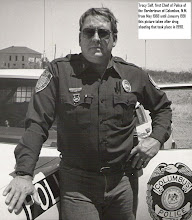
When I was Chief in Columbus in 1989 the museum was robbed of many of the old rifles, and a pistol that were gathered off of the battle field where some of Villa's men were killed as they fled Columbus on the way back to Mexico, by U.S. Army troops defending the town.
Many of the rifles taken were old Kragg Gorgenson bolt actions in 30-40 caliber, and old lever action Winchesters, but the pistol that was taken was one that I had admired ensconced in it's case on previous visits to the museum. It was a Model P Colt, single action revolver in .45 caliber that had a beautiful set of mesquite handles that looked as though they had been hand made by an artisan in Mexico. This revolver is the type seen carried by all of the old western movie stars, Gene Autrey, Roy Rogers and John Wayne.
The rifles were valuable for their historical value, but the revolver not only had historical value, but it had collectors value because it was a 1st generation Colt bearing the serial number of 851 in wonderful condition.The thief had taken the revolver and holding it by the barrel used the handle like a hammer and broke out the glass of the display cases, this caused one of the mesquite grips to fly off of the revolver along with the revolver's main spring, both of which I found on the floor in front of a display case.
When I was called and told about the missing weapons I immediately began an investigation into the crime. I took photos of the damage the thief had done to the display cases in which the weapons were stored for public viewing, and also took finger prints from the glass of the display cases themselves. I did an extra good crime scene investigation because I was aware the the museum board was very upset, and I wanted to make a good impression and solve the case because I was new to the job.
The crime scene investigation itself yielded no suspects, but finally after several weeks I received a tip from an informant who led me to a teen aged boy whose father at one time was a local sheriff's deputy. I was able to get this boy to confess to the theft of the guns, and then he led me to where he had stashed them after the burglary.
After taking the guns from the museum the boy carried them across the street from the museum and into a deep, heavily brush lined wash where he threw the guns into the brush at various locations along the banks of the wash. We found all of the rifles, but we could not find the revolver. He stated to me that when he saw that the pistol was missing a grip panel and the main spring, he threw it in the brush without looking.
I told him that if we had to search the wash all day we were going to find the missing pistol. After a couple of hours of intense searching I finally found the pitol hanging by the trigger guard on a mesquite limb about three feet above the ground.
I was elated to find the missing guns, and the museum board considered me to be the flavor of the month for some time after I recovered the guns, but there was one more problem to overcome. The guns had been left outside for the weeks since they had been taken and they had been rained on which caused their metal parts to have a surface vaneer of rust on them. The museum board decided to have the guns re-blued which would then reduce their value. I tried without success to cause them to just have the guns cleaned only and not re-blued but they insisted. The guns while still retaining their historical value lost much of their collector's value when they were blued.
After the guns were re-blued and placed back in their restored glass cases to be viewed by the public, someone stole the .45 caliber revolver three days after it was replaced in the case. I did an investigation and placed the pistol in the NCIC (National Crime Information Computer) data base, and I have searched for the revolver in every gun show and in every gun shop I have entered since it was stolen, but I have never found it and it has never been recovered by a police agency. I imagine that the revolver is sitting in someones private collecton somewhere and will never be found.
Because the young man who perpetrated the burglary was a juvenile at the time he received a slap on the hands and was released.
The Columbus station is still located in the original location it was in when Pancho Villa raided the town in 1916.
When I was Chief in Columbus in 1989 the museum was robbed of many of the old rifles, and a pistol that were gathered off of the battle field where some of Villa's men were killed as they fled Columbus on the way back to Mexico, by U.S. Army troops defending the town.
Many of the rifles taken were old Kragg Gorgenson bolt actions in 30-40 caliber, and old lever action Winchesters, but the pistol that was taken was one that I had admired ensconced in it's case on previous visits to the museum. It was a Model P Colt, single action revolver in .45 caliber that had a beautiful set of mesquite handles that looked as though they had been hand made by an artisan in Mexico. This revolver is the type seen carried by all of the old western movie stars, Gene Autrey, Roy Rogers and John Wayne.
The rifles were valuable for their historical value, but the revolver not only had historical value, but it had collectors value because it was a 1st generation Colt bearing the serial number of 851 in wonderful condition.The thief had taken the revolver and holding it by the barrel used the handle like a hammer and broke out the glass of the display cases, this caused one of the mesquite grips to fly off of the revolver along with the revolver's main spring, both of which I found on the floor in front of a display case.
When I was called and told about the missing weapons I immediately began an investigation into the crime. I took photos of the damage the thief had done to the display cases in which the weapons were stored for public viewing, and also took finger prints from the glass of the display cases themselves. I did an extra good crime scene investigation because I was aware the the museum board was very upset, and I wanted to make a good impression and solve the case because I was new to the job.
The crime scene investigation itself yielded no suspects, but finally after several weeks I received a tip from an informant who led me to a teen aged boy whose father at one time was a local sheriff's deputy. I was able to get this boy to confess to the theft of the guns, and then he led me to where he had stashed them after the burglary.
After taking the guns from the museum the boy carried them across the street from the museum and into a deep, heavily brush lined wash where he threw the guns into the brush at various locations along the banks of the wash. We found all of the rifles, but we could not find the revolver. He stated to me that when he saw that the pistol was missing a grip panel and the main spring, he threw it in the brush without looking.
I told him that if we had to search the wash all day we were going to find the missing pistol. After a couple of hours of intense searching I finally found the pitol hanging by the trigger guard on a mesquite limb about three feet above the ground.
I was elated to find the missing guns, and the museum board considered me to be the flavor of the month for some time after I recovered the guns, but there was one more problem to overcome. The guns had been left outside for the weeks since they had been taken and they had been rained on which caused their metal parts to have a surface vaneer of rust on them. The museum board decided to have the guns re-blued which would then reduce their value. I tried without success to cause them to just have the guns cleaned only and not re-blued but they insisted. The guns while still retaining their historical value lost much of their collector's value when they were blued.
After the guns were re-blued and placed back in their restored glass cases to be viewed by the public, someone stole the .45 caliber revolver three days after it was replaced in the case. I did an investigation and placed the pistol in the NCIC (National Crime Information Computer) data base, and I have searched for the revolver in every gun show and in every gun shop I have entered since it was stolen, but I have never found it and it has never been recovered by a police agency. I imagine that the revolver is sitting in someones private collecton somewhere and will never be found.
Because the young man who perpetrated the burglary was a juvenile at the time he received a slap on the hands and was released.
Wild Horses?
There is a common misconception in this country with regard to feral horses. There are very few, if any free roaming horses who have not been domesticated at one time and then either released or escaped into the wild. People like to call these horses mustangs, when in reality there is very little if any connection between these types of horses and the horses brought here from Spain by the Conquistadors in the 1500's refered to as mustangs.
In the early sixties in New Mexico there was a rancher in my home town who had a large desert ranch in the area known as the Jornada Del Muerto, the journey of death. This area about one hundred miles long and situated between two mountain ranges was traveled extensively by the early Mexican settlers in New Mexico, because it was safer to travel the Jornada and risk dying of thirst, rather than following the well established trail along the Rio Grande where there was water and risk death by the hand of the Apache.
This is harsh desert land and it suffers no fools, but Pete Graham and his father had operated a re-mount station and raised fine thorobred horses to be sold to the U.S. Cavalry in the late 1800's and early 1900's. When the horse market began to decline in the 1920's and 30's Pete and his dad began to run cattle on their ranch. Pete told me when I was a kid that he could not bear to sell his mare herd so they just let them run wild on the ranch.
By the early sixties the horses on the ranch were so inbred that it was almost impossible to find a solid horse in the herd, there were paints, and grullas and even appaloosas, but few solid colored horses that were worth anything as saddle horses.
Pete allowed us kids to search the herd of horses that at that time amounted to over two hundred animals, and then when we found what we were looking for he would sell us the horse we picked for $25.00., The only trouble being that we had to catch it and get it home. An intimidating job even to us young cowboys with the skills to do it.
My friend Dale and I searched that herd for a long time until we found a nice looking little yearling grulla stud colt that we liked. We set a date to go after him and when the time came we loaded Dale's dad's big gentle stud horse Buttons in the back of their four wheel drive pickup and drove the thirty some odd miles to the Graham Ranch full of anticipation of the thought of trapping this youngster.
Pete Graham built corrals around all of his wind mills for the express purpose of making it easier to trap cattle and horses when they came to water. We went to the well that we knew the herd of horses our little horse belonged to came to water, and there we set the gates open and ready for when the horses came to water in the middle of the day.
We hid the pickup and Buttons the stud in a wash far from the well, and then we hid in the brush ready to jump from hiding and close the gates on the herd when they came in. We didn't have long to wait and when the herd came thundering through the corral gate, we closed the gate and were pleased to find our little horse in the group.
We then sorted out the horses we didn't want back out the gate and they thundered away, the horse we wanted was the only one left in the pen. We retrieved the pickup and backed it up to the loading chute built into the lumber corrals, and then using Buttons we roped the colt by the neck and pulled him up the chute and into the back of the pickup.
We then loaded Buttons into the back of the truck next to the stud colt, and wise old Buttons who had performed this service many times before pushed the much smaller colt against the side of the truck rails and kept him from being able to jump out of the truck as we hauled him down the road.
Dale and I were really excited to return home and begin to work with this young horse, whom we hoped would be trained into a good stock horse. The colt traveled very well down the road with Buttons nudging him when needed and we soon made it back to Dale's dad's place with our prize.
The young horse was perhaps the wildest horse I have ever been around. We were quite concerned that he might try to jump out of the tall corrals at Dale's dad's place. These corrals had been built specifically to contain the wildest horses and cattle, and it seemed that wild horses and cattle were the only kind of animals to be found in this western land.The corrals consisted of ten foot tall tornio posts stacked vertically side by side and then tied into heavy wire stretched between telephone poles that were stuck into the ground two feet deep, the posts shaped into a rectangle about two hundred feet in circumfrance. The pole tied side by side made an inpenetrable barrier that kept in the largest and wildest bulls.
We decided that after we unloaded him from the truck we would then tie a large tire around his neck to stop him from trying to jump out of the corral. We roped the colt, tied the tire to his neck and then let him up. He began looking wildly around the corral for a place to escape, and suddenly when he realized he could move after being confined for so long by Buttons and us, began dragging the tire with him and then backed his butt into the furthest corner of the large corral. He then took off as fast as he could run with the tire around his neck running towards the opposite sides of the corral and then leaping with all of his might straddled his belly on the sharpened tips of the corral poles.
The tips of the poles impaled him, but he struggled until he pushed his whole body over the fence and struc the ground hard, then with his intestines dragging behind him took off in a lope towards the Rio Grande a half mile away. Horrified at what we had just seen, we saddled horses as quickly as possible and went after the doomed colt.
We tracked him by the blood trail he left, but then we lost him in the heavy brush near the river that is almost impossible to ride through on a horse. Dale and I searched all that day, but we did not find the colt and we assumed that he struggled as deeply as he could into the dense brush and died from massive blood loss. We were heart broken and at that time of my life I had never seen anything as horrfying as this happen to an animal.
Although we searched when we could for months afterwards we never found the little colt's body who chose freedom over confinement. Perhaps his death was a freedom to him. Some horses can never be tamed, they will not accept confinement. I have never forgotten the death of this horse and so many times after this event occured I wished that we had never caught the beautiful little colt, and had just let him run free.
In the early sixties in New Mexico there was a rancher in my home town who had a large desert ranch in the area known as the Jornada Del Muerto, the journey of death. This area about one hundred miles long and situated between two mountain ranges was traveled extensively by the early Mexican settlers in New Mexico, because it was safer to travel the Jornada and risk dying of thirst, rather than following the well established trail along the Rio Grande where there was water and risk death by the hand of the Apache.
This is harsh desert land and it suffers no fools, but Pete Graham and his father had operated a re-mount station and raised fine thorobred horses to be sold to the U.S. Cavalry in the late 1800's and early 1900's. When the horse market began to decline in the 1920's and 30's Pete and his dad began to run cattle on their ranch. Pete told me when I was a kid that he could not bear to sell his mare herd so they just let them run wild on the ranch.
By the early sixties the horses on the ranch were so inbred that it was almost impossible to find a solid horse in the herd, there were paints, and grullas and even appaloosas, but few solid colored horses that were worth anything as saddle horses.
Pete allowed us kids to search the herd of horses that at that time amounted to over two hundred animals, and then when we found what we were looking for he would sell us the horse we picked for $25.00., The only trouble being that we had to catch it and get it home. An intimidating job even to us young cowboys with the skills to do it.
My friend Dale and I searched that herd for a long time until we found a nice looking little yearling grulla stud colt that we liked. We set a date to go after him and when the time came we loaded Dale's dad's big gentle stud horse Buttons in the back of their four wheel drive pickup and drove the thirty some odd miles to the Graham Ranch full of anticipation of the thought of trapping this youngster.
Pete Graham built corrals around all of his wind mills for the express purpose of making it easier to trap cattle and horses when they came to water. We went to the well that we knew the herd of horses our little horse belonged to came to water, and there we set the gates open and ready for when the horses came to water in the middle of the day.
We hid the pickup and Buttons the stud in a wash far from the well, and then we hid in the brush ready to jump from hiding and close the gates on the herd when they came in. We didn't have long to wait and when the herd came thundering through the corral gate, we closed the gate and were pleased to find our little horse in the group.
We then sorted out the horses we didn't want back out the gate and they thundered away, the horse we wanted was the only one left in the pen. We retrieved the pickup and backed it up to the loading chute built into the lumber corrals, and then using Buttons we roped the colt by the neck and pulled him up the chute and into the back of the pickup.
We then loaded Buttons into the back of the truck next to the stud colt, and wise old Buttons who had performed this service many times before pushed the much smaller colt against the side of the truck rails and kept him from being able to jump out of the truck as we hauled him down the road.
Dale and I were really excited to return home and begin to work with this young horse, whom we hoped would be trained into a good stock horse. The colt traveled very well down the road with Buttons nudging him when needed and we soon made it back to Dale's dad's place with our prize.
The young horse was perhaps the wildest horse I have ever been around. We were quite concerned that he might try to jump out of the tall corrals at Dale's dad's place. These corrals had been built specifically to contain the wildest horses and cattle, and it seemed that wild horses and cattle were the only kind of animals to be found in this western land.The corrals consisted of ten foot tall tornio posts stacked vertically side by side and then tied into heavy wire stretched between telephone poles that were stuck into the ground two feet deep, the posts shaped into a rectangle about two hundred feet in circumfrance. The pole tied side by side made an inpenetrable barrier that kept in the largest and wildest bulls.
We decided that after we unloaded him from the truck we would then tie a large tire around his neck to stop him from trying to jump out of the corral. We roped the colt, tied the tire to his neck and then let him up. He began looking wildly around the corral for a place to escape, and suddenly when he realized he could move after being confined for so long by Buttons and us, began dragging the tire with him and then backed his butt into the furthest corner of the large corral. He then took off as fast as he could run with the tire around his neck running towards the opposite sides of the corral and then leaping with all of his might straddled his belly on the sharpened tips of the corral poles.
The tips of the poles impaled him, but he struggled until he pushed his whole body over the fence and struc the ground hard, then with his intestines dragging behind him took off in a lope towards the Rio Grande a half mile away. Horrified at what we had just seen, we saddled horses as quickly as possible and went after the doomed colt.
We tracked him by the blood trail he left, but then we lost him in the heavy brush near the river that is almost impossible to ride through on a horse. Dale and I searched all that day, but we did not find the colt and we assumed that he struggled as deeply as he could into the dense brush and died from massive blood loss. We were heart broken and at that time of my life I had never seen anything as horrfying as this happen to an animal.
Although we searched when we could for months afterwards we never found the little colt's body who chose freedom over confinement. Perhaps his death was a freedom to him. Some horses can never be tamed, they will not accept confinement. I have never forgotten the death of this horse and so many times after this event occured I wished that we had never caught the beautiful little colt, and had just let him run free.
Death in the Snow.
That late winter day in 1980 was a continuation of the long Wyoming winter and I began my patrol of the two lane roads in my jurisdiction, vacant of traffic at that early hour. I later traveled back to town after an initial patrol of the area, to get something to eat at Mitchelson's Cafe and visit with the proprietor Mitch Mitchelson, but then in the middle of breakfast I received a telephone call from my sergeant.
He advised that he was enroute to Farson and that he had received information from an oil field crew of a multiple murder scene they had stumbled upon while traveling back from work on an oil derrick north of Farson, in Sublette county; in an area that was technically out of my judicial baliwick.
Gary arrived at my location a short time later and he and I in his car, following the informant who found the bodies in his car, began traveling north towards the location. We turned off of the main highway about fifteen miles north of Farson onto a dirt cow trail and began wending our way northeast towards the foothills of the Windriver mountains, whose mighty peaks dominated the horizon in the distance.
We traveled but a few miles off of the main roadway and into a small barren valley and suddenly we saw in the distance buzzards by the dozen circling objects on the ground, while some birds on the ground were fighting over what appeared to be carcasses of what we found out later were five murdered human beings.
As a side note, when I saw the movie No Country for Old Men recently, it caused me to have flash backs to the killing field I am describing that happened in Wyoming so many years ago.
As we approached the location of the bodies, we were carefull not to destroy any tracks, or evidence at the scene, so we parked the car and walking up to the scene in single file avoiding anything that remotely resembled possible evidence. What we found when we arrived was five hispanic featured men, with their hands tied behind them each possessing large gaping wounds in the back of their heads, each appearing to have been murdered execution style with a large caliber handgun. Their bodies spread out randomly over an area of about twenty five yards.
Their bodies were still in deep rigor, exhibiting blood pooling in the body areas making contact with the ground. We had contacted the Sublette County Sheriff's Office on our way to the scene, and after we completed a preliminary examination of the bodies to determine whether anyone was alive, we secured the scene and then turned it over to the Sheriff of Sublette County in whose jurisdiction the murders had occured, upon his arrival on the scene.
They began one of the most incompetent murder investigations I have ever seen, lacking any kind of investigative protocol, destroyed most of the tire track and foot print evidence that the Sarge and I had been so diligent to preserve before it could be properly recovered.
The Sarge and I gave statements to the investigative officer, and then left in disgust. It was later determined that the five men were illegal aliens from Mexico who had secured a ride with a stranger from where they were working in Idaho intending to make it back to Mexico and that and unkown person had murdered them for the money they were taking back to their families in Mexico.
The Sublette County Sheriff's Office subsequently arrested the wrong man, and Gary and I both testified at his trial as to our involvement in the initial phase of the case. The case was so badly botched that the jury acquitted the man they accused of the crime and to my knowledge no one was ever convicted of this terrible crime.
Five poor little Mexican campesinos, no one but their fatherless families and I remember, and justice was never served.
He advised that he was enroute to Farson and that he had received information from an oil field crew of a multiple murder scene they had stumbled upon while traveling back from work on an oil derrick north of Farson, in Sublette county; in an area that was technically out of my judicial baliwick.
Gary arrived at my location a short time later and he and I in his car, following the informant who found the bodies in his car, began traveling north towards the location. We turned off of the main highway about fifteen miles north of Farson onto a dirt cow trail and began wending our way northeast towards the foothills of the Windriver mountains, whose mighty peaks dominated the horizon in the distance.
We traveled but a few miles off of the main roadway and into a small barren valley and suddenly we saw in the distance buzzards by the dozen circling objects on the ground, while some birds on the ground were fighting over what appeared to be carcasses of what we found out later were five murdered human beings.
As a side note, when I saw the movie No Country for Old Men recently, it caused me to have flash backs to the killing field I am describing that happened in Wyoming so many years ago.
As we approached the location of the bodies, we were carefull not to destroy any tracks, or evidence at the scene, so we parked the car and walking up to the scene in single file avoiding anything that remotely resembled possible evidence. What we found when we arrived was five hispanic featured men, with their hands tied behind them each possessing large gaping wounds in the back of their heads, each appearing to have been murdered execution style with a large caliber handgun. Their bodies spread out randomly over an area of about twenty five yards.
Their bodies were still in deep rigor, exhibiting blood pooling in the body areas making contact with the ground. We had contacted the Sublette County Sheriff's Office on our way to the scene, and after we completed a preliminary examination of the bodies to determine whether anyone was alive, we secured the scene and then turned it over to the Sheriff of Sublette County in whose jurisdiction the murders had occured, upon his arrival on the scene.
They began one of the most incompetent murder investigations I have ever seen, lacking any kind of investigative protocol, destroyed most of the tire track and foot print evidence that the Sarge and I had been so diligent to preserve before it could be properly recovered.
The Sarge and I gave statements to the investigative officer, and then left in disgust. It was later determined that the five men were illegal aliens from Mexico who had secured a ride with a stranger from where they were working in Idaho intending to make it back to Mexico and that and unkown person had murdered them for the money they were taking back to their families in Mexico.
The Sublette County Sheriff's Office subsequently arrested the wrong man, and Gary and I both testified at his trial as to our involvement in the initial phase of the case. The case was so badly botched that the jury acquitted the man they accused of the crime and to my knowledge no one was ever convicted of this terrible crime.
Five poor little Mexican campesinos, no one but their fatherless families and I remember, and justice was never served.
Feral Horse Adventure.
During the winter of 1971-72 fresh out of the Maine Corps I moved my budding family back to my home state of New Mexico with the intent of getting into the cattle business. We moved into a small house located on the edge of the desert near the Uvas Mountains with a view of the Rio Grande Valley north of Radium Springs.
Riding jobs that earned enough to keep my little family going were few and far between, and so I ended going to work at White Sands Missile Range as a steel tier and an apprentice concrete finisher.
On the week ends I cowboyed when I could and looked around for horses to break to supplement our income. In about the middle of March 1972 I saw an add in a paper advertising a horse auction to be held at a location near Alamagordo, NM, the horses being feral horses gathered by the Bureau of Land Management off of the huge White Sands Missile Range.
They were advertising good unbroke saddle stock, mares and studs for the low price of $125.00 dollars a head. I decided to take a horse trailer to the sale with the intent of buying a horse I could break for myself.
On the Saturday of the sale my brother and I hauled a borrowed trailer to the livestock sale in Almogordo about 150 miles away over the San Andreas Mountains to the east of us in the foothills of the San Francisco mountains west of Ruidoso. There were many people already there when we arrived and we saw that the lot of horses numbering about two hundred head were a sorry lot.
There were some old rangy studs and mares, but it appeared that I would not be able to find a good horses in which I wanted to invest my $125.00. After searching and eyeing each horse individually, we finally found a pretty good looking bay stud horse that had some good conformation, but looked as though he had been starved and didn't weigh over 700 pounds but with a little feed he might grow to weigh at least 1,000 lbs.
When the time came I bid on the horse and ended up buying him. Once I had him then came the hard part, getting him loaded into the trailer. It took us about two hours to load him because I didn't have a horse to pull him into the trailer, and no matter how I tried I could not get a mounted cowboy to help me load him. This horse was the kickingest, bitingest animal I have ever seen, he didn't want to load in the trialer and when we finally forced him using ropes, he kicked the trailer sides and fought and whinnied the entire trip back home.
We finally got him home and unloaded him into a small pen I built next to the house just for him. The next morning I started trying to break him, or perhaps he started breaking me. After several weeks of working with the horse I finally concluded that this horse was too old, had been wild too long and had been a stud too long to be much good to me as a saddle horse. I decided to sell him as a bucking horse to a rodeo stock contractor, and he could sure buck.
A strange thing happened with this horse when we had him. If a person entered his pen he would automatically charge towards you and then whirl and kick. Several times he almost gave me a viscious kick in this manner and so I watched him carefully all the time. One Saturday I was home working around the house when my wife screamed at me to look out at the horse corral. I ran immediately to where I could see the horse in the corral and there saw something that made my heart almost stop.
Our fifteen month old toddler Justin was inside the corral sitting directly under this wild horse with him arms wrapped around one of the horse's back legs, pulling his fetlock hair and just cooing away to the horse. I had no idea how he got there, or when he did it, but I knew that it was going to be impossible to get him out from under that horse without him being killed.
The funny thing is that this wild range stud with little to no previous contact with man was standing there like a statue. He did not move a muscle, but his head was turned as far under his body as it would go and he was calmly and softly nickering and sniffing Justin from diaper to head. All this tough old wild horse had to do was step on the little fellow, or kick him and he would be dead.
My wife who has always been a marvel at handling horses walked slowly up to the corral fence and started clucking at Justin saying, "Justin, come on son, come to momma." Justin stayed under the horse for a few more terrifying moments during which time the horse never moved and then with a happy laugh crawled towards his mother and when he was close enough she was able to reach under the corral's bottom rail and snatch him from danger and into her grateful arms.
My wife and I with our little son hugged between us gave a prayer of thanks to our God for saving the life of our little first born son. Unable to break him I eventually sold this horse to a stock contractor who used him as a rodeo bareback bronc horse, and I was told he was a good one. I have always had a soft spot in my heart for this horse who could have easily killed my son, but who seemed to instinctively know he was a baby and nothing to fear.
Riding jobs that earned enough to keep my little family going were few and far between, and so I ended going to work at White Sands Missile Range as a steel tier and an apprentice concrete finisher.
On the week ends I cowboyed when I could and looked around for horses to break to supplement our income. In about the middle of March 1972 I saw an add in a paper advertising a horse auction to be held at a location near Alamagordo, NM, the horses being feral horses gathered by the Bureau of Land Management off of the huge White Sands Missile Range.
They were advertising good unbroke saddle stock, mares and studs for the low price of $125.00 dollars a head. I decided to take a horse trailer to the sale with the intent of buying a horse I could break for myself.
On the Saturday of the sale my brother and I hauled a borrowed trailer to the livestock sale in Almogordo about 150 miles away over the San Andreas Mountains to the east of us in the foothills of the San Francisco mountains west of Ruidoso. There were many people already there when we arrived and we saw that the lot of horses numbering about two hundred head were a sorry lot.
There were some old rangy studs and mares, but it appeared that I would not be able to find a good horses in which I wanted to invest my $125.00. After searching and eyeing each horse individually, we finally found a pretty good looking bay stud horse that had some good conformation, but looked as though he had been starved and didn't weigh over 700 pounds but with a little feed he might grow to weigh at least 1,000 lbs.
When the time came I bid on the horse and ended up buying him. Once I had him then came the hard part, getting him loaded into the trailer. It took us about two hours to load him because I didn't have a horse to pull him into the trailer, and no matter how I tried I could not get a mounted cowboy to help me load him. This horse was the kickingest, bitingest animal I have ever seen, he didn't want to load in the trialer and when we finally forced him using ropes, he kicked the trailer sides and fought and whinnied the entire trip back home.
We finally got him home and unloaded him into a small pen I built next to the house just for him. The next morning I started trying to break him, or perhaps he started breaking me. After several weeks of working with the horse I finally concluded that this horse was too old, had been wild too long and had been a stud too long to be much good to me as a saddle horse. I decided to sell him as a bucking horse to a rodeo stock contractor, and he could sure buck.
A strange thing happened with this horse when we had him. If a person entered his pen he would automatically charge towards you and then whirl and kick. Several times he almost gave me a viscious kick in this manner and so I watched him carefully all the time. One Saturday I was home working around the house when my wife screamed at me to look out at the horse corral. I ran immediately to where I could see the horse in the corral and there saw something that made my heart almost stop.
Our fifteen month old toddler Justin was inside the corral sitting directly under this wild horse with him arms wrapped around one of the horse's back legs, pulling his fetlock hair and just cooing away to the horse. I had no idea how he got there, or when he did it, but I knew that it was going to be impossible to get him out from under that horse without him being killed.
The funny thing is that this wild range stud with little to no previous contact with man was standing there like a statue. He did not move a muscle, but his head was turned as far under his body as it would go and he was calmly and softly nickering and sniffing Justin from diaper to head. All this tough old wild horse had to do was step on the little fellow, or kick him and he would be dead.
My wife who has always been a marvel at handling horses walked slowly up to the corral fence and started clucking at Justin saying, "Justin, come on son, come to momma." Justin stayed under the horse for a few more terrifying moments during which time the horse never moved and then with a happy laugh crawled towards his mother and when he was close enough she was able to reach under the corral's bottom rail and snatch him from danger and into her grateful arms.
My wife and I with our little son hugged between us gave a prayer of thanks to our God for saving the life of our little first born son. Unable to break him I eventually sold this horse to a stock contractor who used him as a rodeo bareback bronc horse, and I was told he was a good one. I have always had a soft spot in my heart for this horse who could have easily killed my son, but who seemed to instinctively know he was a baby and nothing to fear.
Animal Realities.
When I was a child during the 1940's, 50's and 60's New Mexico's population was less than one half million people, most of that amount living in small towns. The predominant income of those who lived outside of the city was agriculture, because the land was only suited for it. Most of the farming being carried out along the Rio Grande, San Juan and the Pecos Rivers, with some dry farming along the eastern border with Texas. Water is the life blood of the desert and livestock raising, or ranching was done where rain runoff could be captured in earthen tanks, or sucked from the ground by windmill power.
The northern regions of New Mexico beginning just a little south of Albuquerque possessed some of the best grassland in the world, and the area where I was born known as the Staked Plains is just a sea of tall flowing grass in good years and it is only suited for cattle production.
The vast majority of southern New Mexico is a harsh desert environment where a rancher can only run a cow calf pair per section of land (640) acres when grass and water is available. It is a difficult, poor way to try to make a living in a treacherous non forgiving environment, but it is a way of life that has been cherished by the ranchers, the Spanish since the late 1500's when the first Spanish soldiers traveled to New Mexico from Mexico.
The first anglos who came to New Mexico in the 1840's fell in love with the beauty of the state and soon adopted the ranching practises of the Spanish settlers. They adopted the language out of necessity to communicate, riding gear of the Spanish vaqueros and today it is hard to distinguish the three major cultures that live and work side by side together in the livestock industry. The Indians being the third culture to adopt the Spanish ranching culture as well.
I am certain that it is difficult to impossible for a person who was not raised in this unique environment to understand it, especially a person who has been raised in the city where dogs and cats are the predominant animal of choice, and they are able to lavish attention on these animals, beloved pets who in essence become a part of the family. I know people who spend thousands of dollars on veterinary bills per year on their pets and this crowd believes that this should be the norm everywhere.
Where I grew up there were no veterinarians, if one was to be found it was necessary to travel a hundred miles to a city such as Albuquerque, Roswell or Hobbs at times to see one and so most ranchers did their own veterinary work themselves. It was necessary to be able to castrate bulls, doctor for screw worms, help pull a calf from its mother, and at times put an animal down that was suffering from an injury that could not be treated. This was reality because of the circumstances.
Because New Mexico was at that time a predominantly livestock state, the laws of the land were written to facilitate the raising of livestock. Loose dogs cannot be tolerated in a livestock environment, and so feral dogs or in some cases dogs who had ecaped an owner in town were killed by ranchers to protect their livestock, and the law was behind the rancher.
If you wanted to keep a dog, keep your dog in your yard. There was no SPCA, or animal pounds at that time nor personnel whose job it was to catch errant animals.
The dog or cat was killed for two reasons: To protect livestock, and as a deterant to hydrophobia that was rampant with skunks. The fear of an animal with hydrophobia was burned deeply into my brain when I was kid because it was a real thing. I knew childhood friends who received the extremely painful injections, and I knew of a child who died a horrible death due to contracting hydrophobia from an infected cat.
I have shot and killed my own beloved dogs whose suffering could not be remedied, one who was dying a horrible death from being bitten in the face by a rattlesnake; his breathing passages shutting off due to the effects of injection of venom from the snake. I have shot and killed horses whose legs were broken beyond repair, who were too far away from a veterinarian and could not have been hauled to one anyhow.
These were life and death issues common to all who live in that harsh environment, and other livestock environments throughout the world. Before anyone judges the harshness used by us to deal with the reality of life, remember to not apply the "norm" of your city life animal care. It does not exist and never will exist in most environments outside of your world.
The northern regions of New Mexico beginning just a little south of Albuquerque possessed some of the best grassland in the world, and the area where I was born known as the Staked Plains is just a sea of tall flowing grass in good years and it is only suited for cattle production.
The vast majority of southern New Mexico is a harsh desert environment where a rancher can only run a cow calf pair per section of land (640) acres when grass and water is available. It is a difficult, poor way to try to make a living in a treacherous non forgiving environment, but it is a way of life that has been cherished by the ranchers, the Spanish since the late 1500's when the first Spanish soldiers traveled to New Mexico from Mexico.
The first anglos who came to New Mexico in the 1840's fell in love with the beauty of the state and soon adopted the ranching practises of the Spanish settlers. They adopted the language out of necessity to communicate, riding gear of the Spanish vaqueros and today it is hard to distinguish the three major cultures that live and work side by side together in the livestock industry. The Indians being the third culture to adopt the Spanish ranching culture as well.
I am certain that it is difficult to impossible for a person who was not raised in this unique environment to understand it, especially a person who has been raised in the city where dogs and cats are the predominant animal of choice, and they are able to lavish attention on these animals, beloved pets who in essence become a part of the family. I know people who spend thousands of dollars on veterinary bills per year on their pets and this crowd believes that this should be the norm everywhere.
Where I grew up there were no veterinarians, if one was to be found it was necessary to travel a hundred miles to a city such as Albuquerque, Roswell or Hobbs at times to see one and so most ranchers did their own veterinary work themselves. It was necessary to be able to castrate bulls, doctor for screw worms, help pull a calf from its mother, and at times put an animal down that was suffering from an injury that could not be treated. This was reality because of the circumstances.
Because New Mexico was at that time a predominantly livestock state, the laws of the land were written to facilitate the raising of livestock. Loose dogs cannot be tolerated in a livestock environment, and so feral dogs or in some cases dogs who had ecaped an owner in town were killed by ranchers to protect their livestock, and the law was behind the rancher.
If you wanted to keep a dog, keep your dog in your yard. There was no SPCA, or animal pounds at that time nor personnel whose job it was to catch errant animals.
The dog or cat was killed for two reasons: To protect livestock, and as a deterant to hydrophobia that was rampant with skunks. The fear of an animal with hydrophobia was burned deeply into my brain when I was kid because it was a real thing. I knew childhood friends who received the extremely painful injections, and I knew of a child who died a horrible death due to contracting hydrophobia from an infected cat.
I have shot and killed my own beloved dogs whose suffering could not be remedied, one who was dying a horrible death from being bitten in the face by a rattlesnake; his breathing passages shutting off due to the effects of injection of venom from the snake. I have shot and killed horses whose legs were broken beyond repair, who were too far away from a veterinarian and could not have been hauled to one anyhow.
These were life and death issues common to all who live in that harsh environment, and other livestock environments throughout the world. Before anyone judges the harshness used by us to deal with the reality of life, remember to not apply the "norm" of your city life animal care. It does not exist and never will exist in most environments outside of your world.
Subscribe to:
Posts (Atom)